
Amazon Prime Day couldn’t keep getting bigger forever. This year’s event, held over 23-26 June, was a little more sedate than previous years – but that’s to be expected after 12 editions.
Prime Day is well established. Its influence on the retail industry and the customer mindset is clear to see.
For retail brands in 2026, Prime Day is still one of the biggest opportunities in the calendar: an opportunity to attract new customers, to capture those who have been eyeing your products, and to forge customer loyalty ahead of Q4.
And if you’re an e-Comas customer, this might have been your best Prime Day yet.
From a continued focus on everyday essentials, to intense cross-channel competition, here are all our learnings from Prime Day 2026.
How did Prime Day 2026 compare to 2025?
Numerator’s Prime Day US live tracker recorded lower figures than Prime Day 2025 almost across the board: from its early read, average order size this year was $47.66, down from $53.34 last year; average household spend was $143.45, down from $156.37 last year.
Around 69% of items purchased sold for under $20, against just 3% above $100. Average spend was $23.23 per item, down from $24.59 last year.
High satisfaction with the deals available was reported at 59%: down from 68% last year.
There’s a recognition from shoppers that Prime Day isn’t quite what it was; brands’ margins are smaller, and therefore so are the deals.
It’s a reminder that for the best conversion rate, your deals don’t necessarily need to offer a massive discount, but a significant one. There’s a thin line to tread in pricing between offering a good deal and obliterating your margin: using Amazon Marketing Cloud (AMC) and other analytics tools can help you find the best prices to convert.

The top selling categories and items during Prime Day 2026
This year the most commonly purchased categories in the US, according to Numerator, were:
- Apparel & shoes
- Household essentials (e.g. cleaning products, paper products, batteries, etc.)
- Health & wellness (vitamins, supplements, medicine)
- Beauty/cosmetics
- Home goods (bedding, décor, furniture)
- Groceries
- Pet products (food, treats, toys)
- Consumer electronics
- Small appliances (coffee maker, blender)
- Toys/video games.
These largely continue the trend of the last few years: where Prime Day was once the time to grab big discounts on electronics, appliances and media, it’s now more of a chance to stock up on necessary household items.
That said, it’s interesting to see that clothing and shoes have risen to the top, as historically, these weren’t Amazon’s strong suit.
The top five best-selling items in the US by units sold, according to Numerator, were:
- Premier Protein Shakes
- Liquid I.V. Packets
- Temptations Cat Treats
- Dawn Powerwash Spray
- Hefty Ultra Strong Trash Bags.
Note all of these products lend themselves well to the “buy again” and “subscribe & save” buttons. If your brand serves a similar category, Prime Day can help you build serious customer loyalty.
The power of Prime Day
Prime Day is a powerful marketing tool for Amazon, creating enormous loyalty and returning customers. 93% of all Prime Day shoppers knew it was Prime Day before shopping, and 89% said they had shopped Prime Day in the past. 93% had been a Prime member for over a year.
Note that 45% of shoppers reported purchasing an item they had been waiting to buy until it went on sale: proof of the power of Prime Day in people’s minds.
The summer sale is now ON
Prime Day’s influence on the entire retail industry is enormous: competition to lure shoppers from Amazon is fierce. Thousands of platforms and individual brands had their own summer sales in the same week, including Walmart, Target, Best Buy, Nordstrom, Wayfair, Trip.com and many more.
As a result of these sales, many Prime Day shoppers compare prices across retailers before buying on Amazon: more than half, according to Numerator. They also engage with competing promotions: 49% shopped or planned to shop Walmart Deals, and 32% shopped or planned to shop Target Circle Deal Days.
During Prime Day week, brands should be mindful of prices across their own webshop and other platforms as well as Amazon: shoppers will hunt around to find the best deal. Some of our clients promoted their own ‘summer sale’ in the same week on their social media and email campaigns: a sure-fire way to drive up traffic to deal pages.
Learnings from Prime Day 2026 for e-Comas and our clients
At e-Comas we bucked the trend: our clients saw great success through all four days of Prime Day.
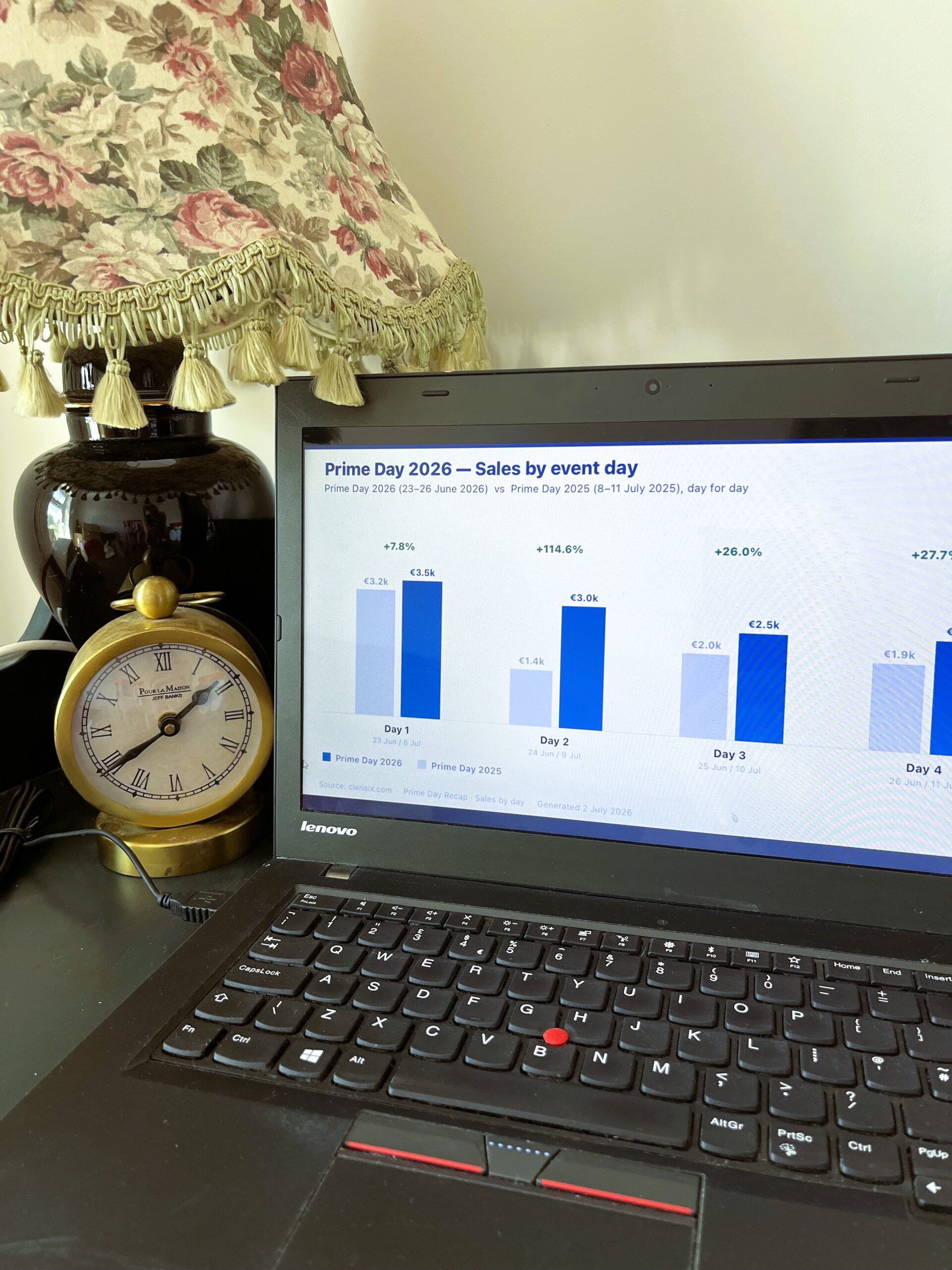
Overall, revenue for all our clients was up by 23.8% vs Prime Day 2025*.
Same as last year, the most popular day was the first with sales decreasing by an even amount over the next three. All four days saw higher sales across our clients than last year. Units sold were up by 20%, and conversion rate increased by 1.7 percentage points.
For us, the biggest growth was in the personal care, home & kitchen, wellness & supplements and baby & toddler categories, which tallies with the wider trends.
Typical for us was a client who saw 297 units sold, up 25% on last year, with ACOS of 36.7% and total sales of €11.4k, vs. €8.5k last year.
Another client, a high-end kids lunchbox and drinkware brand, saw a whopping 87% increase on day 1 of Prime Day 2026 compared to day 1 of Prime Day 2025, and 194% increase over average daily sales in May 2026. This demonstrates how many shoppers will wait for Prime Day before making vital seasonal purchases, like back-to-school equipment.
*All e-Comas data from Clarisix
Learnings from Prime Day 2026: take your results further
It’s never too early to start planning for the next Prime Day.
With the next Amazon Prime event due in October, now is the best time to look at what worked and what didn’t – which products moved fast, which keywords converted, which ads worked, whether the budget lasted as expected, whether inventory was forecast correctly – and build on your successes.
Don’t forget to look at the lead-in and lead-out phases around Prime Day, which can give you fantastic data on your conversion rates and ad effectiveness. Use AMC to analyse your results: we recommend the Amazon Tentpole Phase Analysis report, which analyses the main KPIs across the lead-up, main event and lead-out times.
We’ve used this report to check a client’s Purchase Rate across Prime Day, and found that most traffic came through the lead-out phase, while higher ROAS was recorded during Prime Day. However, the highest Purchase Rate came from the combination of the three phases.
That means that shoppers who saw our ads throughout the three phases were the most likely to convert.
Clarisix, e-Comas’s proprietary platform for analysing results across six streams – sales, ads, margins, inventory, content, and customer experience – offers fantastic Prime Day data and insights.
You can compare revenue, units sold, ad sales, conversion rate, new-to-brand rate and ACOS with the previous year’s Prime Day or with a previous period.
Coming soon will be custom events, so you can analyse specific time periods unique to your brand, and pre-defined events, such as Black Friday/Cyber Monday, back-to-school, Mother’s Day, etc.
Clarisix is currently available in beta at a special founding rate, locked in for life, for early customers. Visit clarisix.com